

Selwyn Fellow and Cambridge ecologist Professor Lynn Dicks visited Shandong Province, East China, on a research exchange, travelling from experimental peanut fields to a reclaimed shrimp farm on the Qingdao coast and observing the wildlife clinging on in between.
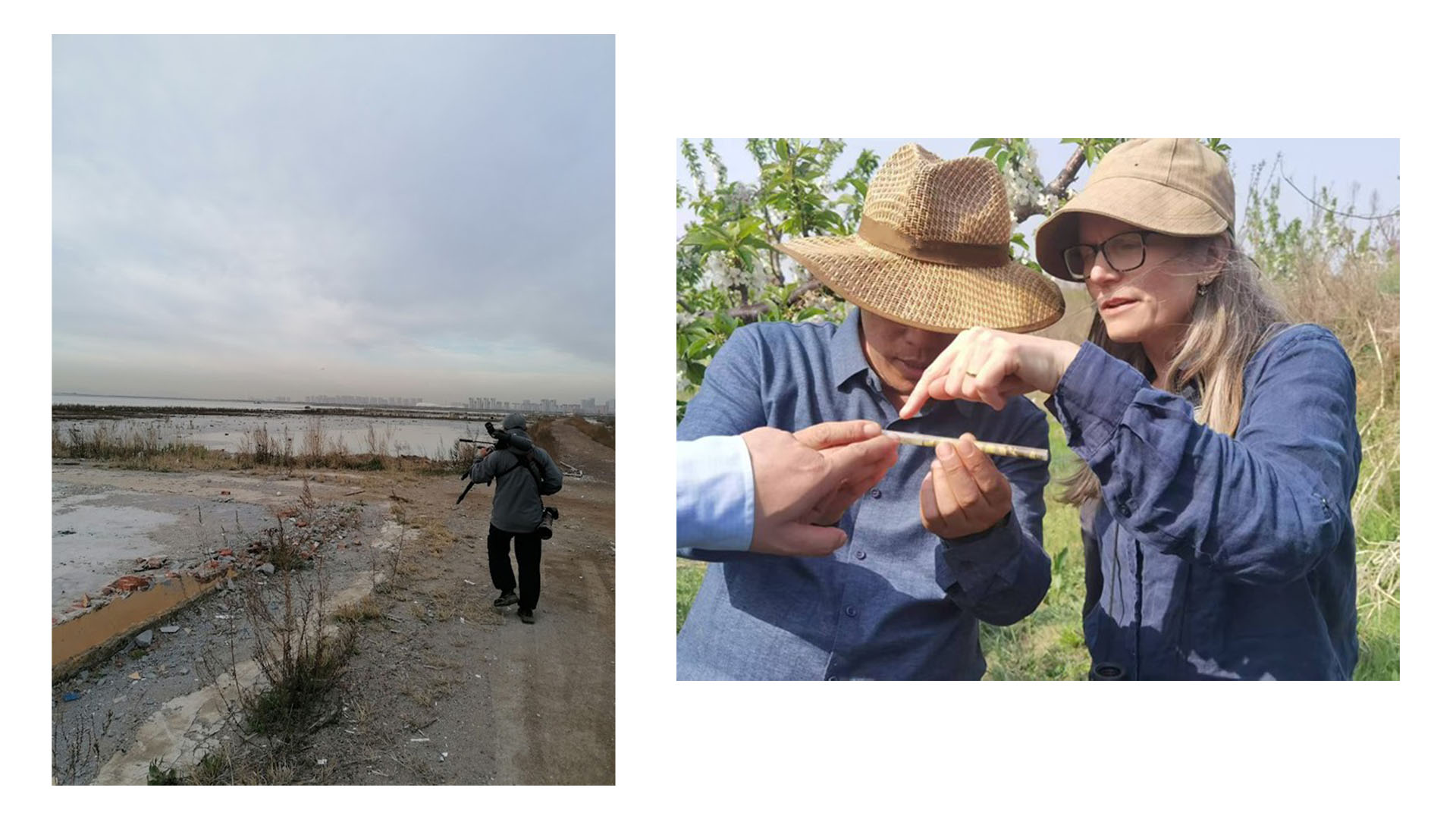
Right: Discussing mason bee rearing techniques in Yantai.
Research exchanges work well when there is learning on both sides. I arrived in Shandong, presented my work on insect decline, then followed my hosts at the Shandong Academy of Agricultural Sciences into the field. I saw innovations in action and came away with plans for future collaboration.
Helping predators to protect peanuts The visit began at a field station, where the President of the Entomological Society of China, Professor Ge Feng, introduced me to his group, which produces seeds and tests plant species for sowing functional flower strips. These are designed to host ‘natural enemies’ such as ladybirds, which can control pests in a range of important crops, including peanut, cotton, wheat and corn. The flower strips provide energy resources and refuge, especially between crops over the winter. My group has already completed collaborative work with Professor Ge Feng on the effectiveness of this system, published last year (Ju et al 2025). Later, I saw strips of the most successful ‘functional plant’ for hosting natural enemies, Shechuang (Cnidium monnieri), being planted alongside peanuts at an experimental field site. I was impressed by the team’s approach to promoting ecological approaches as innovative technology, including very clear, engaging communications on why farmers need to think about ecology. Much of Chinese agriculture is incredibly intensive and these ideas are just beginning to gain ground in China.
Agroecology in action for apples I visited apple orchards and mason bee rearing facilities in Yantai, hosted by Professor Men Xingyuan. Here we saw a great deal of innovation, including a bespoke machine to manufacture cardboard tubes specifically designed for the local mason bee species, Osmia excavata, which is a mud-collecting, cavity-nesting bee species and a great pollinator for apples. We also saw a harmonic radar system, used to monitor the foraging range of individual female mason bees. I observed adoption of agroecological innovations in several commercial orchards, one large intensive operation acting as a popular demonstration site for other growers. These innovations included ‘functional plants’ between the apple rows, designed by Professor Ge Feng, and several biological control measures such as targeted pheromone disruption for pests.
In Qingdao, I presented our thinking from the Cambridge Agroecology group on how functional biodiversity can be supported in agricultural landscapes to avoid whole system degradation, without compromising food production. This is key to securing a long-term future for food, but it must sit alongside protection of natural habitats and their associated bioabundance, to prevent the complete loss of other wild species to extinctions. The larger-scale, strategic thinking about reconciling agriculture and biodiversity conservation that predominates in the Cambridge Conservation Research Institute was an important source of discussion and knowledge exchange.
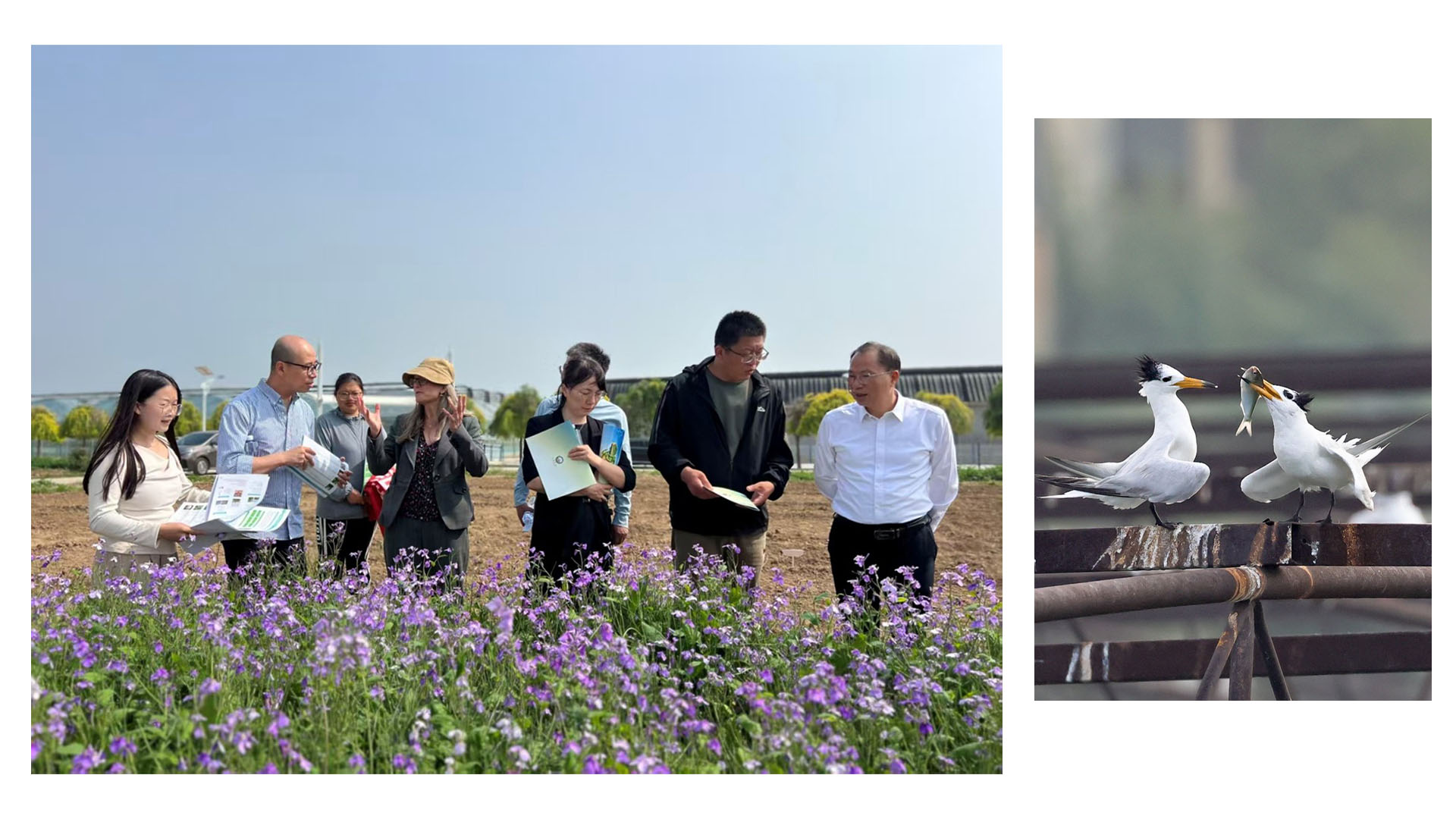
Right: The critically endangered Chinese crested terns gather in Jiaozhou Bay.
Protecting globally endangered shorebirds One early morning, I joined two knowledgeable members of the Qingdao Birding Association for a spell of birdwatching. We visited Jiaozhou Bay, a new bird reserve on the coast of Qingdao, slowly being restored from its previous use for intensive shrimp farming, thanks to the continuous hard work of local birders. We saw a host of beautiful shorebirds, including three globally endangered species, the Nordmann’s greenshank (Tringa guttifer), the Siberian sand plover (Charadrius mongolus) and the Far Eastern curlew (Numenius madagascariensis). The curlews were pulling quite large crabs out of the mud, and it was a joy to see them alongside their more familiar, smaller cousins, Eurasian curlews. We saw beautiful pied avocets (Recurvirostra avosetta) incubating eggs and black-winged stilts (Himantopus himantopus). The site has recently started to be used by the critically endangered Chinese crested tern (Thalasseus bernsteini) as a migration staging post, where they feed and train their juveniles between June and November. It was sobering to see these special birds making their lives in such an ex-industrial context, with litter and abandoned infrastructure around them and so close to the developing mega-city of Qingdao.
Generous hosts My visit was organised and led by two collaborators and visiting scholars in the Agroecology group: Professor Zhaoke Dong, who worked with us on the Global Insect Threat Response Synthesis (GLiTRS) and Professor Qian Ju, with whom we recently collaborated on research into the effectiveness of the Shechuang flower strips in supporting pest regulation services for aphid control in peanuts. We made plans for ongoing collaboration, including using the large-scale network of field research stations in Shandong to explore questions about the long-term success of ecological intensification and insecticide-free approaches.