

Moz Thomas (SE 1993) has spent three decades at the centre of the digital age. He is currently at Amazon leading the transformation of Prime into an agentic experience, and often gets asked about artificial intelligence and where it is taking us. He reflects on how the tech industry has moved faster than society’s ability to absorb it.
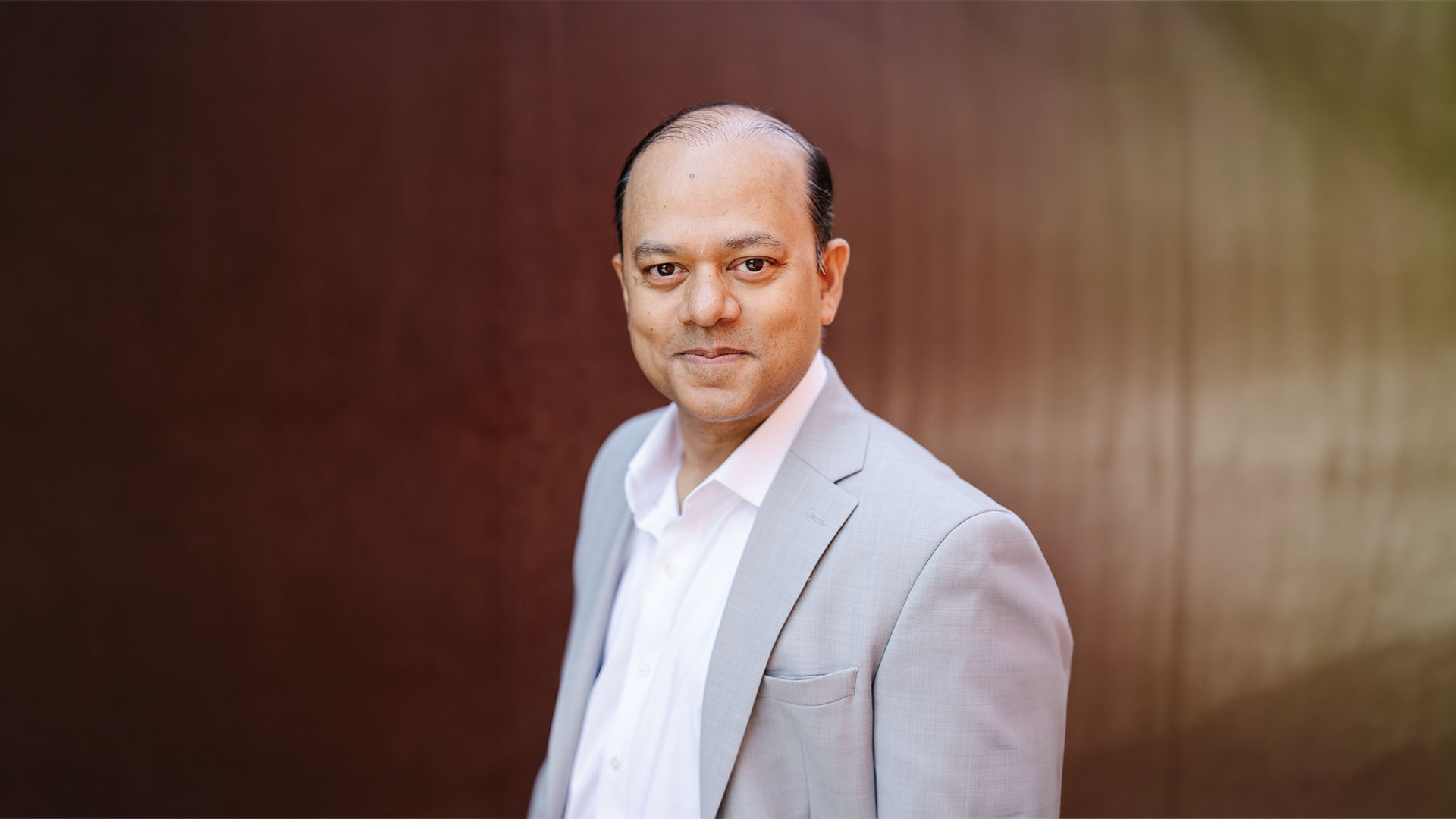
AI doesn't get up and say, I want to go to Mars. That’s a human dream. AI isn’t very good at orchestrating people with different motivations towards a shared vision. And AI is not very good at making ethical judgement calls. In a hypothetical case, if your car was out control, would you run over your 95-year-old grandfather or a young mother with a six-month-old baby? There isn’t a right answer, but humans understand those nuances. AI just breaks down.
He is equally clear about what AI can do. “It can turbocharge progress in some of our most pressing challenges — healthcare, climate change, education and much more. It can put human dreams within reach. While we should not stop this innovation, we also need to recognise the limits and where humans are needed.”
It is a perspective built over a long career. He came to Selwyn to read Chemical Engineering. What shaped him most, he reflects, was the supervision system. “You don’t realise it at the time, but every supervision is training you to present an idea, defend an idea, show your working and deeply understand a problem. It makes you genuinely fearless in high-stakes conversations later in life.” Following university, he became a strategy consultant, working in high tech during the early days of companies trying to make sense of the internet. When his manager left to found a startup and pulled him in, a pattern was set. “The lesson I draw from that and repeat often: great careers are built by jumping on open doors, not waiting for the perfect plan.”
He moved to the US and joined Microsoft, where he initiated the company’s original investment in Facebook when it had revenues of only $50 million. “I once worked on a feature that would have allowed users to share their search history with their social network. Mark Zuckerberg had a theory — we called Zuckerberg’s Law: people will share twice as much personal information every year in exchange for a service they value. He was correct. Whether that outcome was governed well is a different question entirely, and one the industry still hasn’t answered satisfactorily.”
The moment that crystallised the reach of what he was building was in 2006. He was in an internet café in Beijing doing customer research and saw people logged in and enjoying a product he had built. “They had no idea who I was, but I had sweated over every feature and every pixel they were playing with. Seeing that joy was extraordinary.”
When he graduated in 1997, many of today’s jobs were unheard of. “Whoever had heard of a social media influencer then, or an AI prompt engineer?” The disruption ahead, he argues, is similarly unpredictable — but navigable. “You are less likely to lose your job to AI than to another human who uses AI better than you.” Before a recent family trip to South Korea, he used AI to build a personalised travel guide for each of his wife and three sons, tailored to exactly what they find interesting. “That was simply not possible even 12 months ago.”
And this returns him to his generation’s responsibility. “My generation built the foundations: the PC on every desktop, scaling the internet and inventing uses for it. We became the managers and investors as Millennials built social media and AI on top. I am proud of the innovation. I am less comfortable with the governance deficit we leave behind.” The next generation must be in that room when that governance model is defined. “Do not allow my generation to write all the rules for your future. My 16-year-old navigates misinformation more fluently than many of my senior colleagues. That native fluency is exactly the capability needed to govern AI in a way that is principled rather than merely reactive. Be optimistic about what the technology makes possible. But be present, and be vocal, in deciding how it develops.”