
Professor Philippa Browning (SE 1976) was among the first women to study at Selwyn, arriving 50 years ago in 1976. This year she retired as one of the leading figures in plasma physics. Here she reflects on the science, and on a career shaped by persistence and discovery.
I joined Selwyn aged 16 in 1976, the first year women were admitted, reading Mathematics. My grandfather, Herbert, and father, John, were Selwyn graduates, and my elder brother Tim was studying there, so the choice was natural. I earned a scholarship through my entrance examination, but college rules had not yet been amended to award one to a woman — this was changed a year later. Remarkably for that time three of the six Mathematics students in my year were female, although women were still very much in the minority across the university. A First Class degree and then Part III (now MMath) in Applied Mathematics followed. I then went to St Andrews for PhD research into magnetic fields in the solar atmosphere, supervised by Professor Eric Priest.
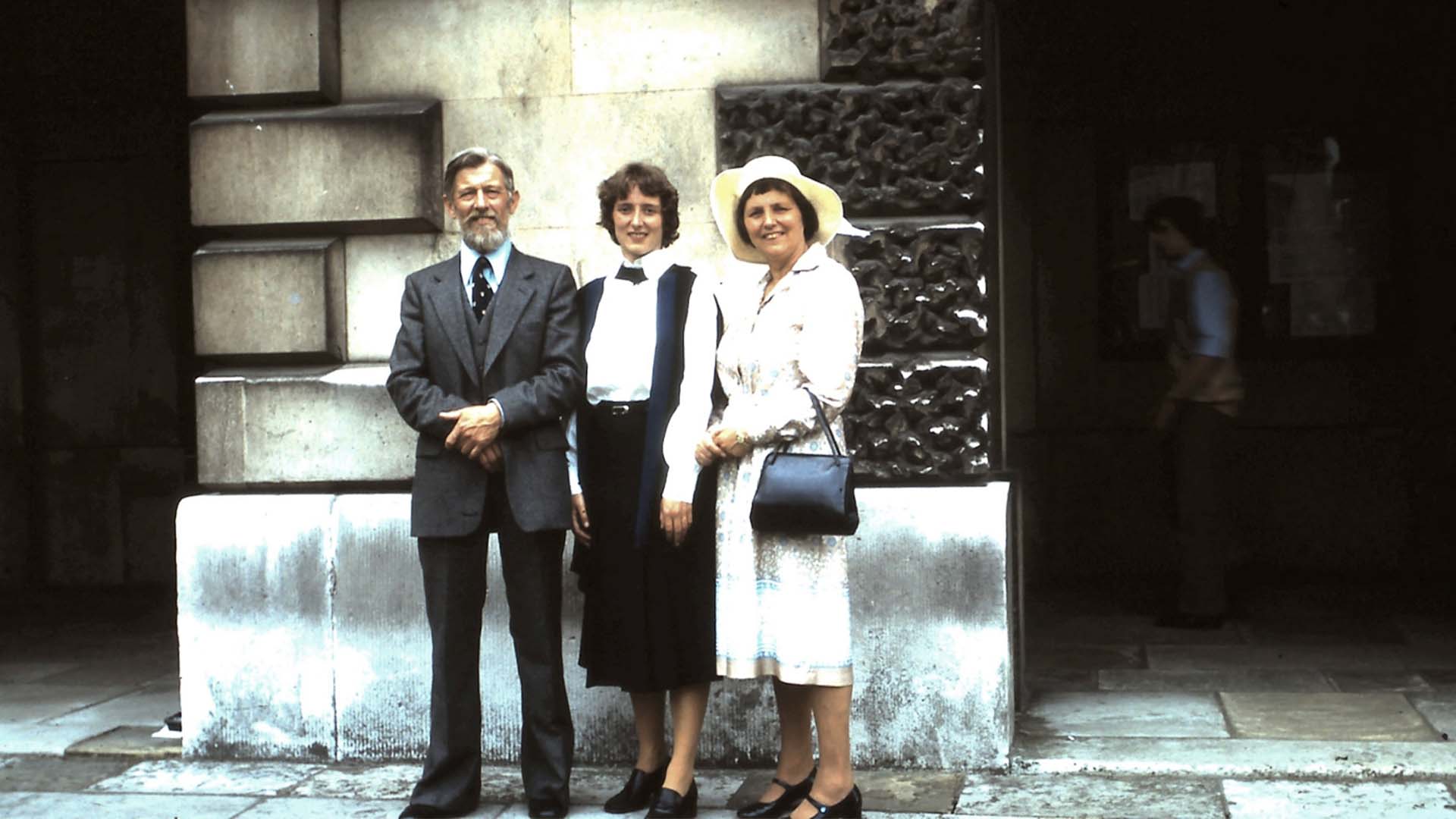
In 1985 came an appointment to a Lectureship in physics at the University of Manchester Institute of Science and Technology (UMIST): the first woman physics lecturer at either UMIST or the University of Manchester; the two institutions later merged in 2004. That post became the frame for the rest of my career before I retired this year. Although I will continue to be active in research and the academic community as Professor Emerita, I am enjoying life beyond physics, including walking, playing the viola (recently resumed after a gap of almost 50 years) and spending time with my granddaughter Morgan.
None of it was uncomplicated. I have combined my career with family life — raising my son and two step-children — at a time when there were no role models to follow and childcare provision was not well established. I met my husband Ivan, a psychologist and artist, at St Andrews. Like many academic couples, we faced the so-called “two-body problem”. I was very lucky to get a job at UMIST a year after Ivan moved to Manchester.
WHY PLASMA MATTERS
Plasmas make up the vast bulk of matter in the universe, so they are central to understanding the cosmos and have practical uses on Earth, from fusion energy to lighting and medicine. Plasma is the fourth state of matter, consisting of a sea of positively-charged ions and negatively-charged electrons which conduct electricity and can be controlled by magnetic fields.
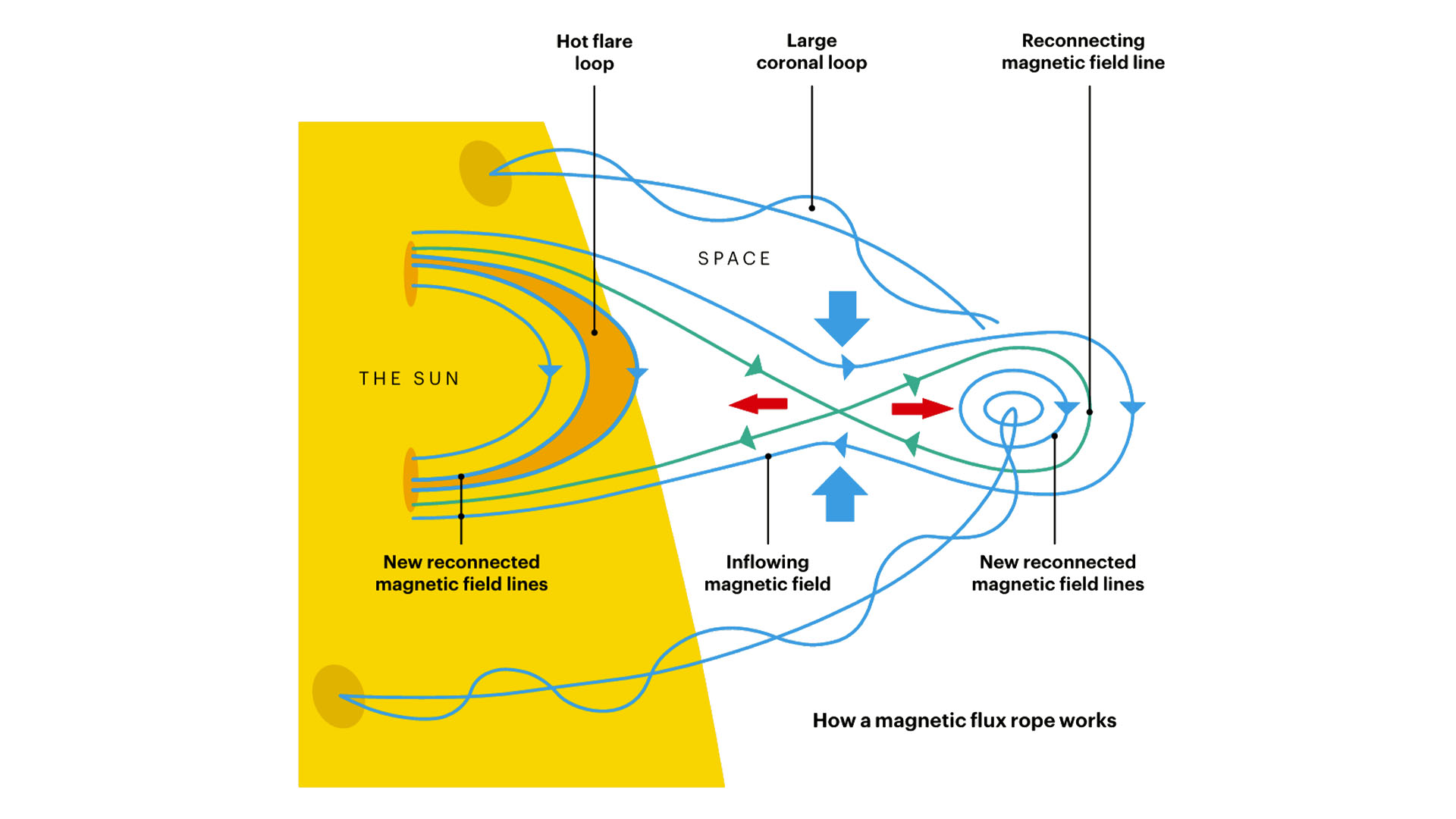
Over my career, I have studied the complex interactions of plasmas with magnetic fields both in the atmospheres of the Sun and stars and in laboratory experiments on Earth, finding the connection between them. These environments contain twisted bundles of magnetic field lines, known as flux ropes.
My research uses mathematical modelling and computer simulation, building on my undergraduate training in fluid dynamics, but I have also worked closely with laboratory experiments and solar observations. I am especially interested in the fundamental physical process of “magnetic reconnection” in which field lines break and rejoin, rapidly releasing magnetic energy which can heat the plasma and accelerate charged particles. This plays an important role in both laboratory and solar plasmas.
A central thread of my work has been showing how magnetic structures in plasmas can become unstable and suddenly release stored energy.
WHAT IS MAGNETIC FLUX ROPE?
Twist a length of rope tightly enough and it will buckle and coil in on itself. Magnetic field lines in the Sun’s outer atmosphere can behave in much the same way, winding into braided, helical structures that store enormous quantities of energy.
These flux ropes can remain stable for days. But if the twist becomes too great, they become unstable, releasing that stored energy suddenly and violently. This is the kink instability — a central theme of Philippa Browning’s research — and it is one of the triggers for solar flares and the coronal mass ejections that send clouds of magnetised plasma hurtling into space.
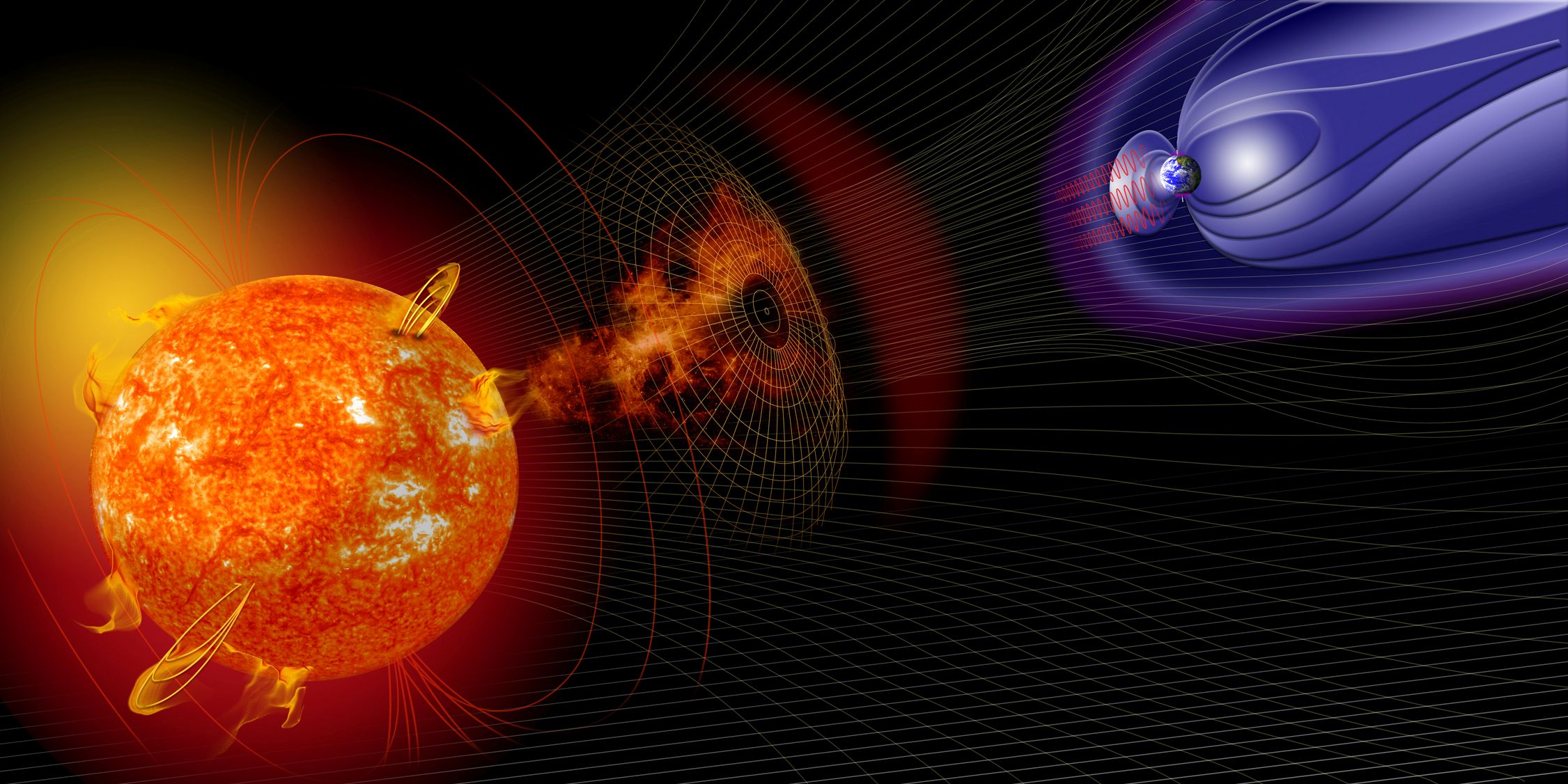
When those ejections reach Earth, the consequences are practical as well as spectacular. On 13 March 1989, a coronal mass ejection hit the Earth’s magnetic field. Ninety seconds later, the entire Hydro Québec power grid failed. Six million people lost power for nine hours.
Understanding and predicting solar flares has thus become a key problem in modern science, and will also build new understanding of explosive events across the universe.
THE PROMISE OF FUSION
Fusion — in which hydrogen nuclei are combined into heavier helium — is the energy source of the Sun and stars, and would be a very attractive future source of power for electricity generation on Earth.
In fusion reactors, forms of hydrogen such as deuterium are combined to produce helium. This means large quantities of energy are created from a small quantity of fuel: the lifetime energy needs of one person could be supplied from a bathtub of water and the lithium in two laptop batteries.
The process is inherently safe, and the waste product, helium, is harmless. However, there are huge technical challenges, as fusion requires effective containment of a very hot plasma (around 100 million Kelvin). This can be achieved using magnetic fields, and I have contributed to the quest for magnetically-confined fusion throughout my career.
At UMIST, I led the theoretical programme for the spheromak experiment, in which the plasma was confined within a spherical container — contrasting with the conventional approach of toroidal (ring-shaped) containers. A long-standing question in plasma physics was how a plasma relaxes to its state of minimum magnetic energy. We discovered that this results from the large-scale instability and localised turbulent fluctuations. The spheromak programme also led to the building of one of the world’s first spherical tokamaks: a concept which has become very successful and is now the chosen path for a potential UK fusion reactor in the government-funded STEP programme.
Philippa's career in brief
Education
Carmel College, Oxfordshire.
Millfield School, Somerset.
Mathematics, Selwyn College, Cambridge.
PhD, University of St Andrews.
Career
1976 Joined Selwyn College.
1984 Completes PhD at St Andrews; continues as a postdoctoral researcher with Professor Eric Priest, working on solar plasmas.
1985 Appointed Lecturer at UMIST.
2004 Joins the University of Manchester following the UMIST merger.
2009 Becomes Professor at the Jodrell Bank Centre for Astrophysics.
2026 Retires from the University of Manchester, appointed Professor Emerita.
Honours and awards
2009 Elected Fellow of the Institute of Physics.
2016 Awarded the Chapman Medal of the Royal Astronomical Society.
2026 Awarded the Hannes Alfvén Prize, European Physical Society.
THE MYSTERY OF THE SUN
The solar outer atmosphere, the corona, is dynamic and is driven by strong magnetic fields. Solar flares — the most energetic explosions in the solar system — release large quantities of energy (up to the order of 10²⁵ joules). They can have significant impacts on the Earth and our space environment, affecting satellites and their instrumentation, human spaceflight and even aircraft, power systems and communications.
This phenomenon, known as space weather is an increasing concern as our dependence on satellites grows. Flares are caused by a release of stored magnetic energy through magnetic reconnection.
I proposed that this can be triggered by the kink instability in flux ropes, forming many localised current sheets where magnetic reconnection dissipates magnetic energy. This heats the plasma and accelerates charged particles to close to the speed of light. A longstanding puzzle in astrophysics is to understand how the corona is maintained at a temperature of around 1 million Kelvin, whereas the surface is only at 6000 K.
My colleagues and I worked out how this can result from the combination of many small flares, using magnetohydrodynamic simulations to show that a disturbance in one magnetic flux rope can set off an avalanche of heating events, just as a small snowball can trigger a snow slide in the mountains.
The 2026 Hannes Alfvén Prize, awarded by the Plasma Physics Division of the European Physical Society (EPS) for outstanding contributions to plasma physics arrived with a particular kind of meaning. It was awarded to me for work linking the physics of the Sun with fusion experiments on Earth.
When I first attended an EPS Plasma Division meeting in the early 1990s, there were no female speakers in plenary or parallel sessions, and I did not even hear any women ask questions after talks.
Receiving the prize this year, and giving a plenary talk at the conference, feels like one small sign of how far women’s careers in physics have come since then.