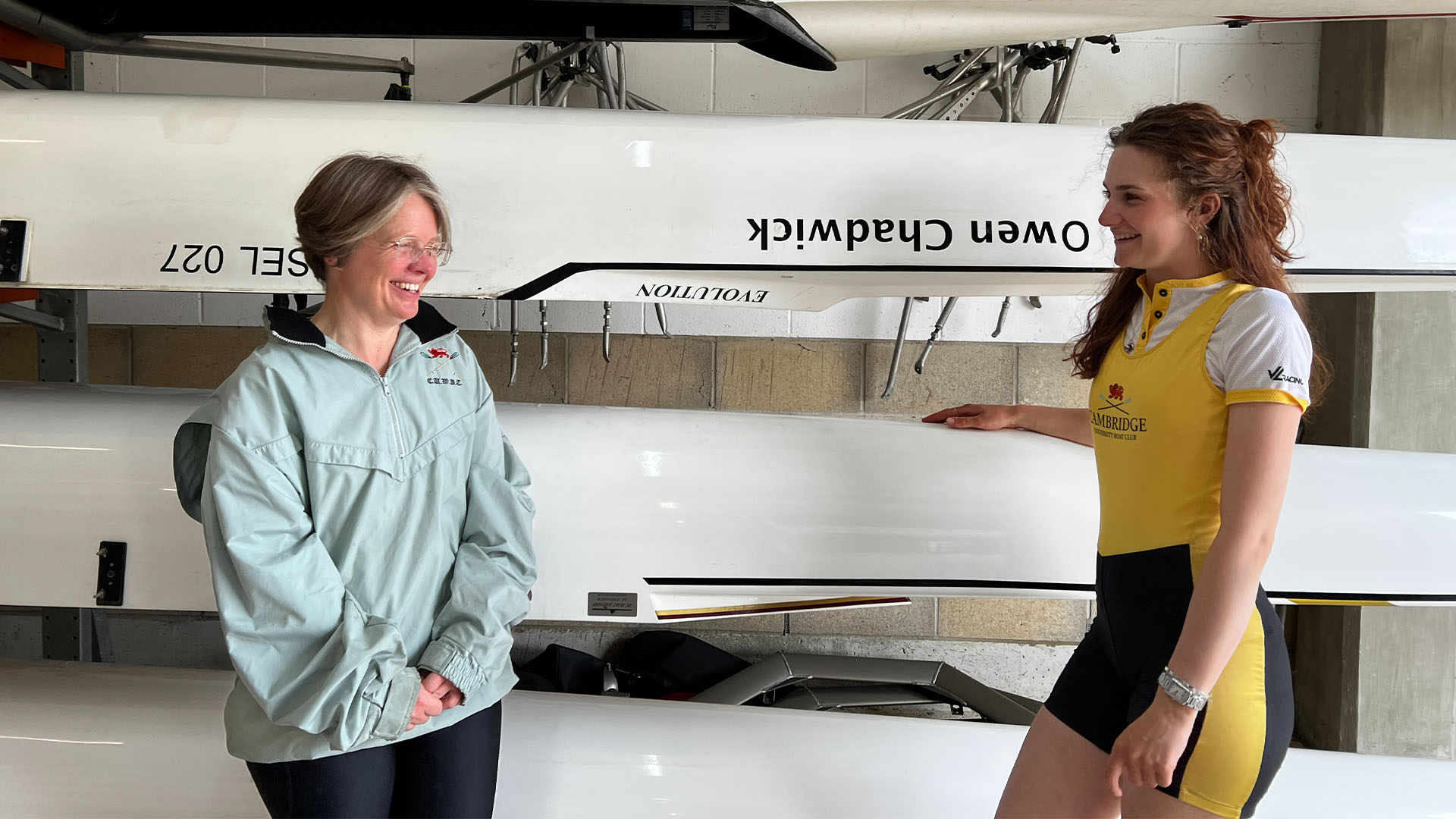
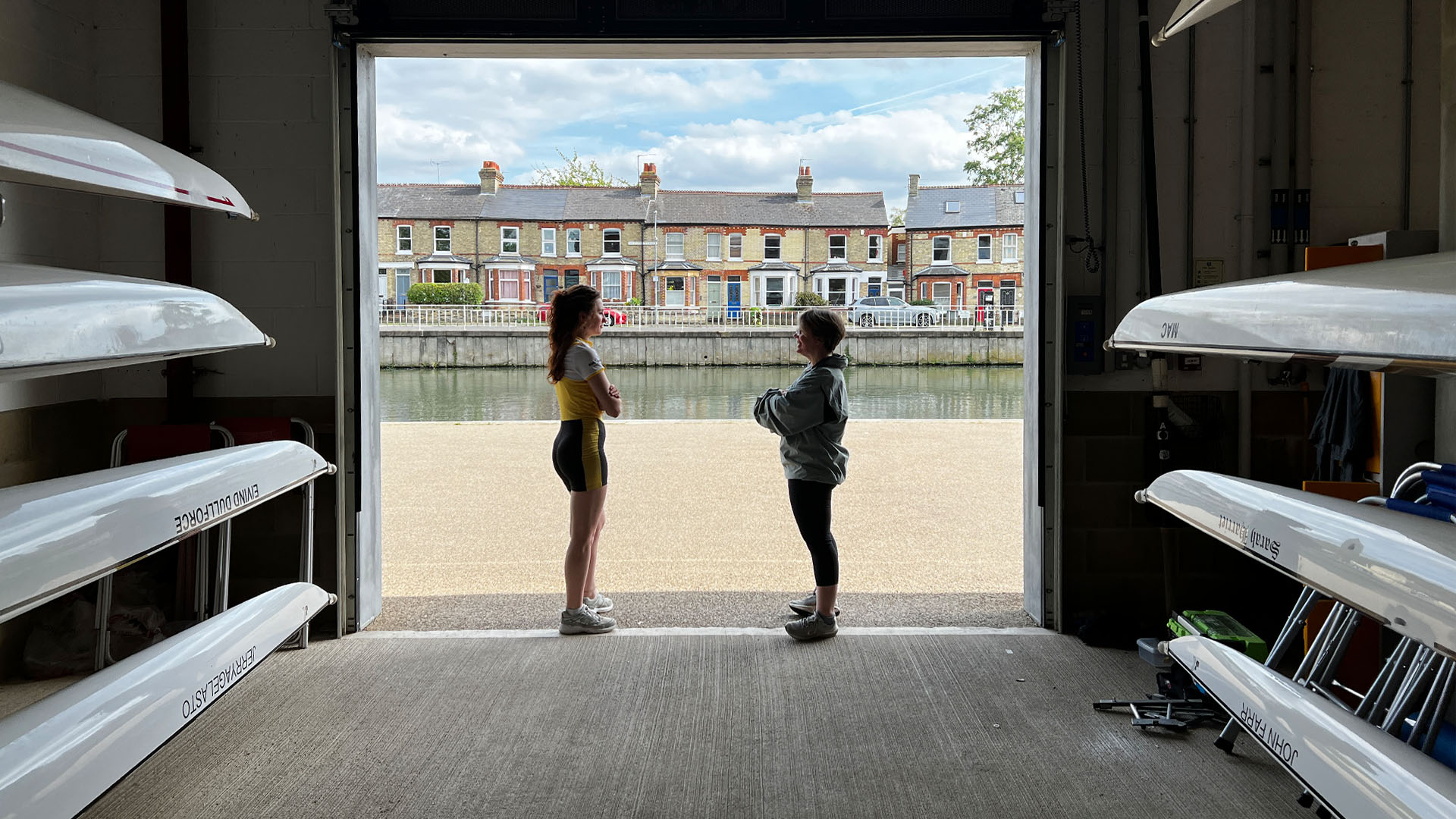
Two Cambridge University coxes, decades apart, reflect on their lives on the Cam. Selwyn’s Freya Jenkinson (SE 2022) coxes today, and the College’s Bursar Jennifer Phillips, coxed in the 90s. Both describe the pressure and camaraderie of the sport.
It’s the 6 October 1996, and a self-proclaimed “short and mouthy” first-year has climbed on to a table during freshers’ week to bring order to the chaos of new students around her. This display catches the attention of her college boat club members. A week later, despite never having rowed before, she is coxing the novice men’s crew. Three years later, she will steer the 1999 Cambridge women’s Blue Boat to victory over Oxford by one and a quarter lengths on the Henley course.
That former fresher is Jennifer Phillips, Selwyn’s Bursar. “My brothers joke that I have a Blue for exercising my vocal muscles,” Jennifer says with a laugh. When she was coxing, on-board speaker systems or cox boxes were already in use in some senior crews, but nonetheless a cox’s greatest asset might still have been considered volume. Today, you’d be hard-pressed to find a cox without one. As Selwyn languages student, and university-level cox, Freya Jenkinson puts it: “The job today is about steering and communicating with the crew through the speakers – it’s much easier on the vocal cords.”
What has not changed, both past and present coxes are keen to emphasise, is the early-morning magic of the Cam. “Watching the sun rise as you train is one of the most beautiful sights, particularly when it’s a bit frosty and the mist is slowly lifting from the river,” says Freya. However, rowers are not the only inhabitants of the Cam on those crisp early mornings. “Swans with cygnets, quite understandably, don’t appreciate students rounding corners at speed where their offspring are tucked away in the reeds,” Jennifer says. On that occasion, she found herself being pursued by an angry swan. She remembers: “Its beak was about two metres from my head.” Her repeated cries of ‘up two’ (or please go faster) proved entirely futile. Wings slapping the water, the swan just kept pace with the boat. “That isn’t to say I didn’t keep saying it anyway,” she adds. Only when they were 100 metres clear did the satisfied swan drift back to its cygnets.
The pressure of steering a crew away from a territorial swan is nothing compared to the intensity of race day. As Freya explains: “In race situations, coxing becomes incredibly exciting because you carry out the plan, motivate the crew in front of you and push them to their limit. It can be nerve-wracking, because while a cox might not be the reason a crew wins, they can very easily be the reason it loses. Sitting on the start line, you really feel the weight of that responsibility.”
In a sport where there is no option but to show up for one another because, as Jennifer puts it, “you can’t row along with two of the blades sitting on the water”, shared commitment forges bonds that last well beyond the river. “I’ve made some of my best friends at Selwyn College Boat Club,” says Freya, adding that she has felt “continual support from members past and present.” For Jennifer, the relationships she made while coxing for the university have also endured. Returning for the 25th anniversary of her Boat Race, she found the closeness intact, along with the same playful humour: “They definitely tried to pick me up and put me in something. I had to say, ‘excuse me, I’m nearly 50, can we move on from that?’”