


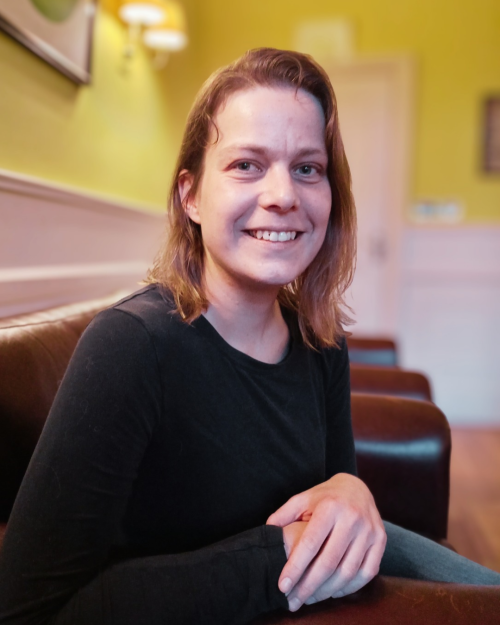
Dr Sophie Richter, a Trevelyan Research Associate at Selwyn, has been awarded an Academy of Medical Sciences Starter Grant to study how nutritional deficiencies affect recovery from traumatic brain injury in older adults.
“Head injuries are so common,” she said. “It’s estimated that one in two people worldwide will have one at some point in their lives.”
Her new project will ask whether good nutrition explains why some older adults recover better than others.
“Every head injury is very different, because every brain is different before the injury, and the injury itself is different too,” she said. “We’ve lumped together lots of people whose problems are very different. If we better understand what has happened in the brain, we can find better targets for treatment.”
Sophie divides her time between the emergency department at Addenbrooke’s Hospital and research at the University of Cambridge, where she is an NIHR Clinical Lecturer in Emergency Medicine.
Sophie has worked on head injury since 2015. Most people with a mild head injury recover, however some live with lasting symptoms even when their scans look normal. Much of her research so far has aimed to make those hidden injuries visible, using advanced MRI and computer programs that extract detail about the brain’s structure that the naked eye cannot see, to predict who will recover and who will not.
She is also the Cambridge site lead for BRAINS-TBI, a study run by her former PhD supervisor, Professor Virginia Newcombe. It is testing whether blood tests can show which patients need a CT scan, sparing others unnecessary radiation, and pick out those likely to have long-term symptoms.
Her research has run alongside her clinical training. After her medical degree and two foundation years came six years of emergency medicine training, during which she also completed a three-year PhD. She now works half in clinical practice and half in research, and has had two children along the way.
She did her PhD at Homerton and joined Selwyn in January 2024, looking for a college with more senior clinicians for mentoring.
In December 2025 she explained her work to Fellows in a talk called “What do the Moon and the brain have in common?”. It took its theme from a favourite German poem, Matthias Claudius’s Evening Song, in her own translation:
Look at the moon so lonely,
one half is shining only,
yet she’s round and bright.
Thus oft we laugh unknowing
at things that are not showing,
that are still hidden from our sight.