


A new book examining quantum technologies as they move from research into commercial reality has been co-authored by Selwyn Fellow, Professor Chander Velu.
Quantum technologies harness the physics of sub-atomic particles to achieve what would otherwise be impossible. Microprocessors in our computers and MRI scanners already rely on quantum physics. However, newer quantum technologies by manipulating unexploited quantum phenomenon are creating capabilities in a wide range of applications like computing and communications.
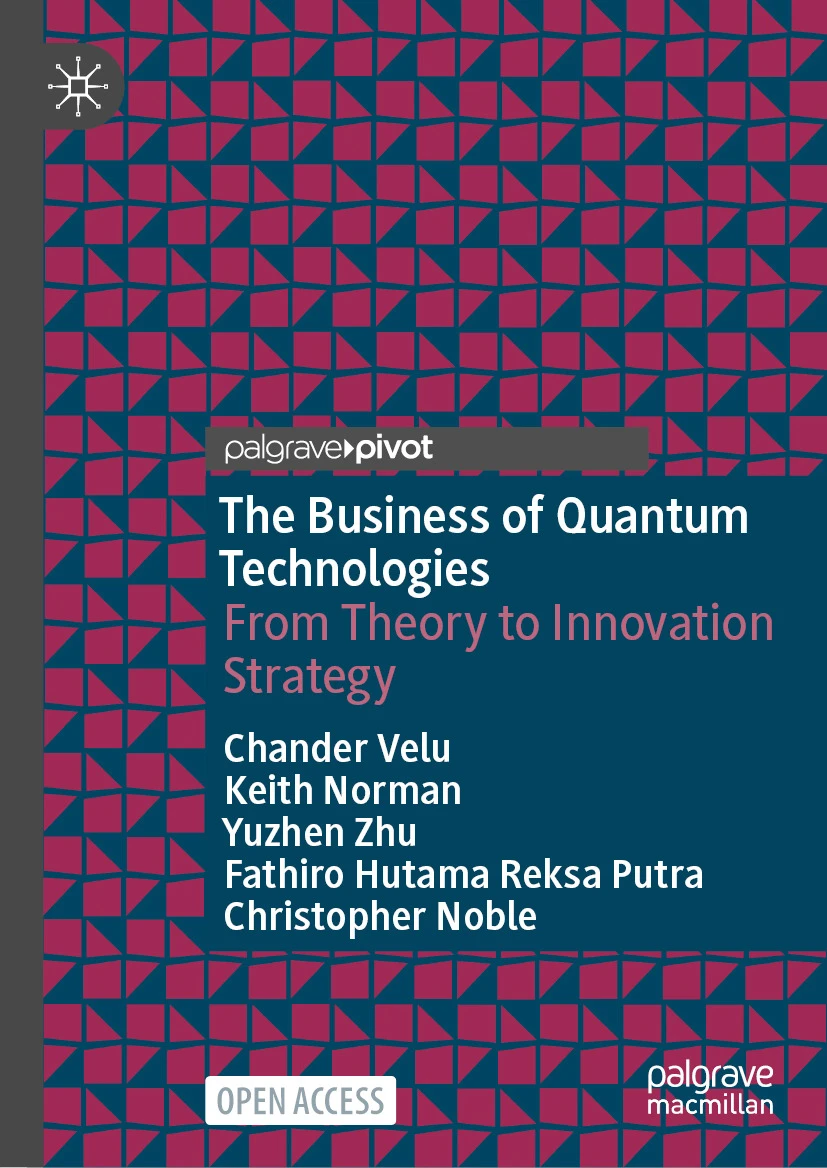
The Business of Quantum Technologies: From Theory to Innovation Strategy examines applications in healthcare, financial security, climate monitoring, and transport among others. Chander, Professor of Innovation and Economics at the Institute for Manufacturing, wrote the book with Keith Norman and Christopher Noble from Oxford, Yuzhen Zhu from University of East Anglia, and Fathiro Putra from Bandung Institute of Technology.
The open-access book explains how organisations might adopt quantum computing, communications, sensing, imaging and timing technologies.
- Quantum computing enables faster computation to address challenges such as climate resilience, financial stability, new drug and materials discovery.
- Quantum communications provide the basis for more secure communications and protection of sensitive data.
- Quantum sensing allows for better detection of faults in hard-to-reach infrastructure below ground level such as gas pipelines or improved navigation of autonomous vehicles.
- Quantum imaging provides the basis for more precise health care applications such as brain imaging.
- Finally, quantum clocks would enable more accurate timing for optimising and providing resilience to critical national infrastructure such as transport, financial services and energy systems.
The book aims to provide an intuitive explanation of the technology with an emphasis on the conceptual frameworks to better understand the economic and managerial implications. In doing so, the book explores how strategy and business model innovation needs to be formulated to enable the adoption and integration of quantum technologies in organisations, and highlights the related policy issues.
As Chander notes: “The time is ripe for scholars, managers, and policy-makers to work together to enable quantum technologies to address grand societal challenges, while contributing to productivity and economic growth in a responsible and sustainable manner.”
This comes as the UK government has invested over £1 billon in the UK National Quantum Technologies Programme (NQTP) and has emphasised quantum technologies as a key driver for economic growth as part of its modern industrial strategy. Global investment reached $33 billion in 2025 and could potentially generate close to $100 billion in revenue by 2035.
The book is available here: The Business of Quantum Technologies