
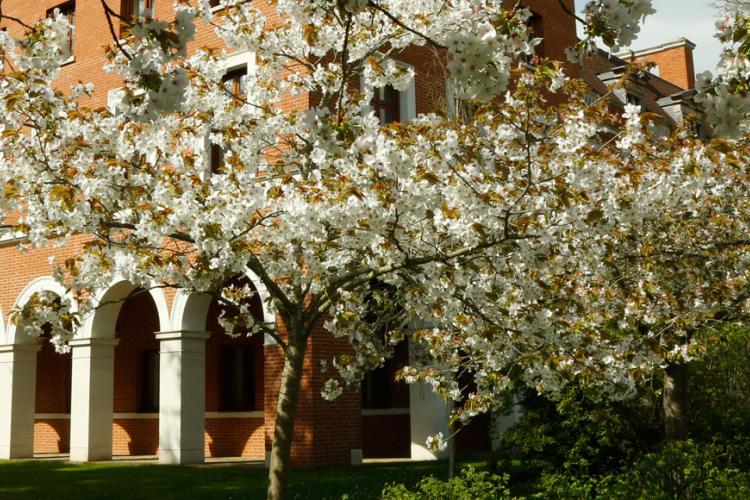

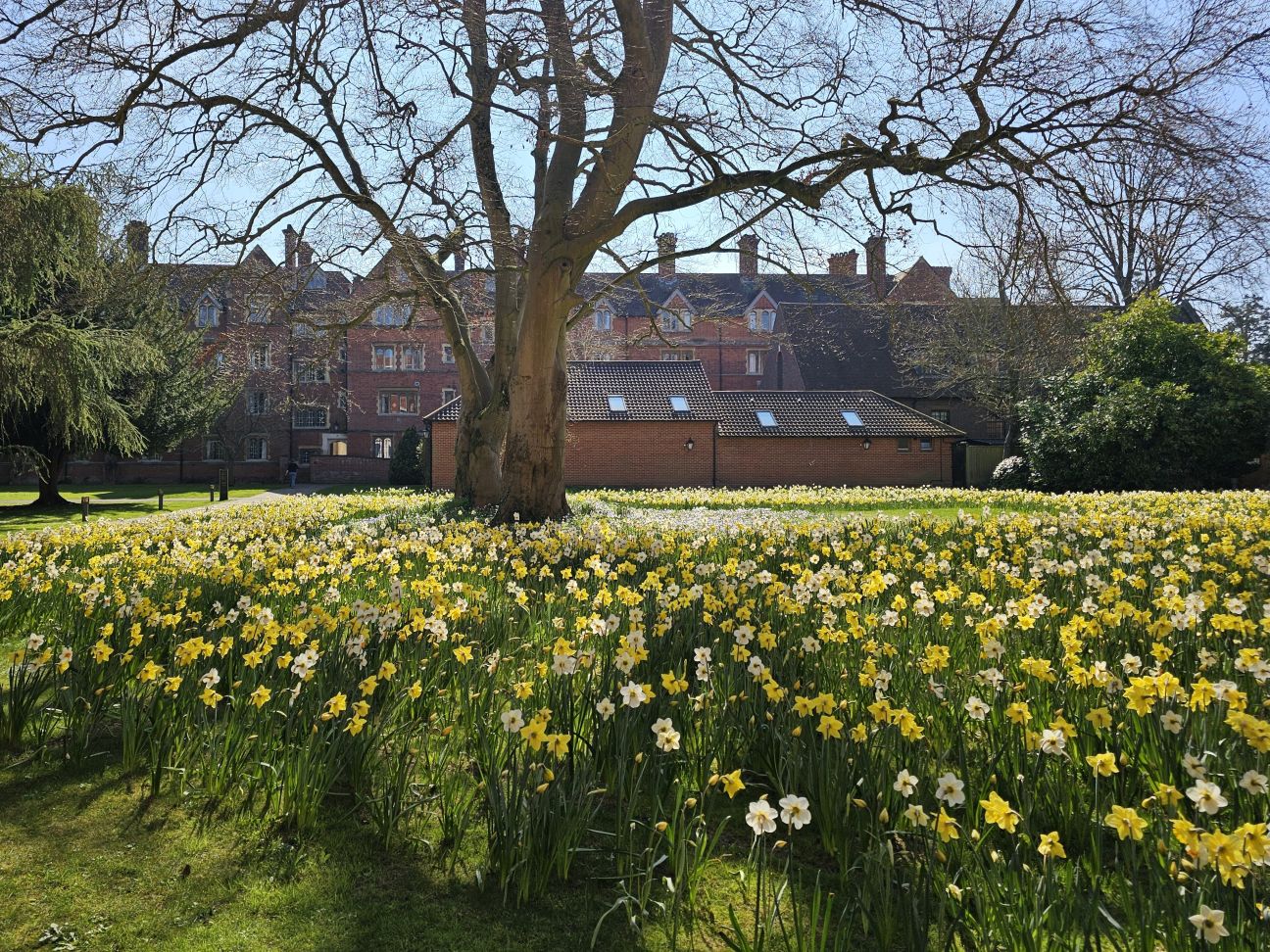
The ground between the Old Library and Ann's Court offered an opportunity for improvement. Until autumn 2024, it was an uneven lawn which was difficult to maintain. Thanks to the Friends of Selwyn Gardens, our gardeners masterminded a transformation, planting 40,000 bulbs including narcissus, tulips, camassia and snowdrops.
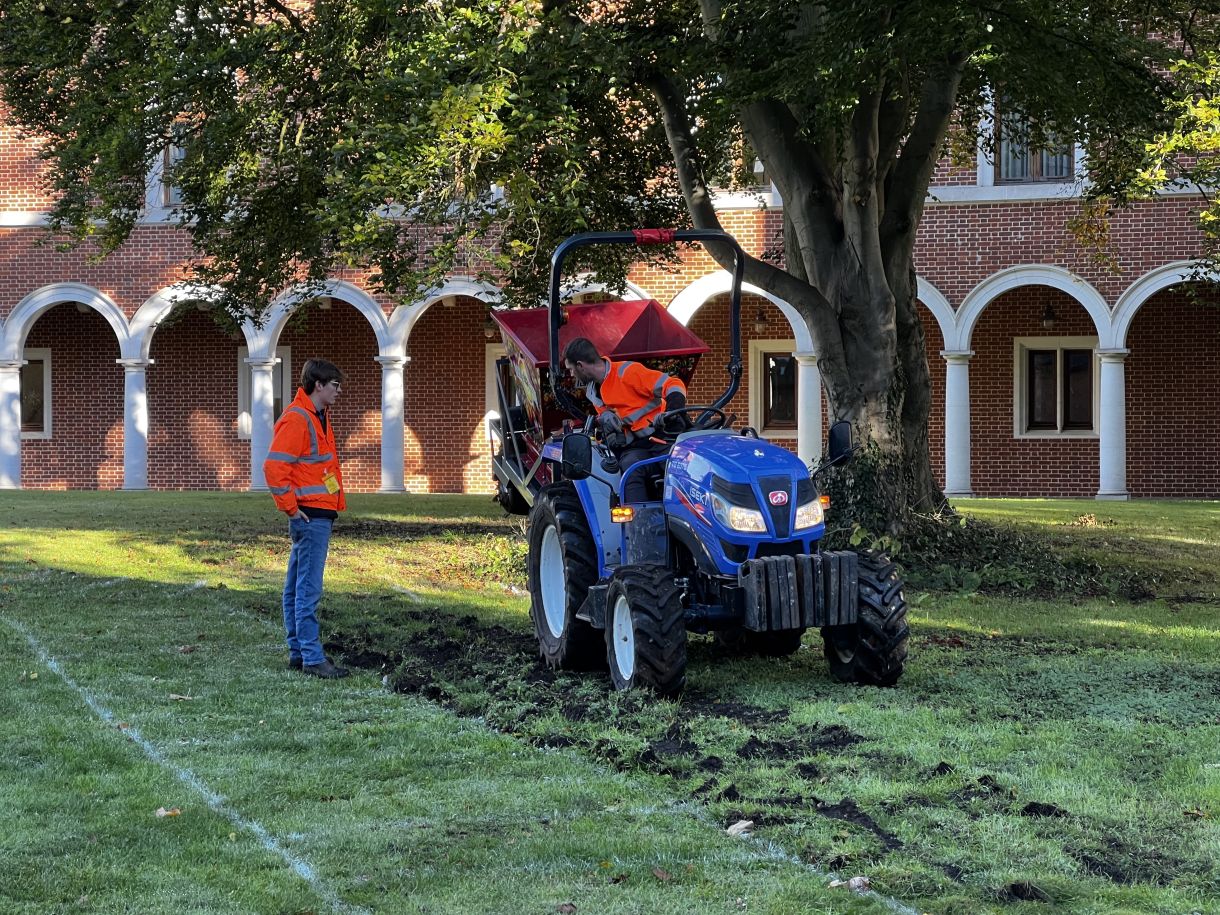
Specialist contractors used a machine that lifted a one metre strip, scattered bulbs beneath it, and re-laid it in a single continuous pass.
The area was prepared for sowing a perennial wildflower mixture of 33 species. Seed was sown in spring 2025 and again in spring 2026. Some plants, such as Pilosella aurantiaca (fox and cubs), were transplanted from elsewhere in the gardens. Paths crossing the meadow are kept as grass and mown when needed.
|
|
A flowering season
The meadow will move through four waves of colour from early spring through to autumn. Narcissus will open the season, with successive varieties carrying the display through the colder months. Wild tulips will follow, and are expected to naturalise and strengthen in coming years. The vivid blue spires of camassia will close the bulb season. Through summer and into autumn, 33 species of perennial wildflower should take over, including knapweed, ox-eye daisies, yellow rattle, wild sorrel and fox and cubs.
| Season | What's flowering |
|---|---|
| Early spring | Narcissus |
| Mid spring | Wild tulips |
| Late spring | Camassia |
| Summer to autumn | Knapweed, ox-eye daisies, yellow rattle, wild sorrel, fox and cubs and 28 further species |
Biodiversity
Biodiversity in the meadow was high in the first growing season, summer 2025. Bee orchids (Ophrys apifera) were already growing in the area — a plant that thrives only in undisturbed, nutrient-poor ground. The meadow is designed to change character from year to year as the perennial wildflowers mature and find their place among the grasses. The area is left rough through winter to shelter invertebrates and seed-eating birds, with uncut stems providing structure and habitat long after the last flowers have faded.